
Media
Books
Media
Books
The Map as Art: Contemporary Artists Explore Cartography
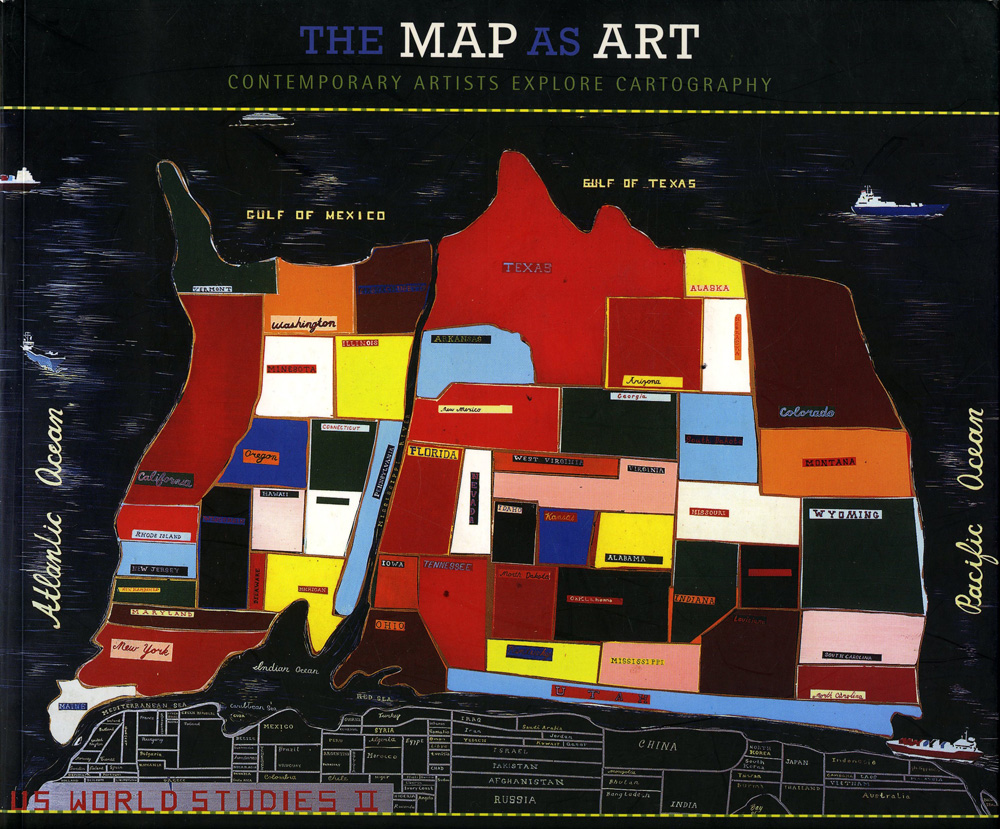
Clemans, Gayle. “Landon Mackenzie: The Politics of the Land.” Essay from The Map as Art: Contemporary Artists Explore Cartography. Arranged by Katherine Harmon, Published by Princeton Architectural Press, 2009. Pages 66-71.
You may never have been to the places that Landon Mackenzie so closely maps in her art of the last fifteen years: Canada’s Saskatchewan, Athabasca, and Houbart’s Hope. But as you become immersed in the paintings’ washes of color, immense scale, and layers of information and line, it is easy, almost unavoidable, to become intimately acquainted with the histories and spaces of Mackenzie’s artistic world.
Mackenzie, who lives and works in Vancouver and on Prince Edward Island, has explored the places that inspire her art, but to a large extent these places are also fictions constructed of various perceptions and myths, both personal and cultural. Mackenzie gathers these stories and assesses how they were spawned by geographic terrain and sociopolitical ideologies. She then transforms data and fantasy into large, abstract paintings. She begins with canvases that are seven and a half feet tall by ten and a quarter feet long (“big enough to get lost in”‘) and layers them with color, line, text, and texture. The colors are soft, modulated, and sensual; and seem dyed rather than built up. Mackenzie’s active lines, circular shapes, and handwritten texts suggest geographic and astronomical maps, charts, diaries. The energetic interplay of color, shape, and line evoke topographic features like prairies or rivulets or marvelous events like star showers or cascading fireworks.
Prior to her mapping works, Mackenzie created paintings with abstract figures and suggestions of geography. The Lost River paintings of the 1980s are abstract, moody, and mystical landscapes. Mackenzie placed silhouetted animal figures within flat planes of color or alongside geometric lines, reminiscent of fences or graphs.
The art world—after years of focusing on conceptual and completely abstract, formalist art—had begun lauding figurative, representational painting again; Mackenzie’s Lost River paintings attracted a lot of attention.
Mackenzie herself was trained in these conceptual and formalist traditions and was considered a sign-bearer of the reemergence of the image in painting.
“I usually work over long periods of time on several canvases simultaneously until stories and constructs begin to manifest a terrain or pattern that I can follow, like a trail or a puzzle that provokes my imagination and my analytical mind during the process of building a picture” – Landon Mackenzie (Canadian, b. 1954)
This was also a time of heated debate about Native American and First Nations rights, particularly surrounding the contested ownership of territory. Mackenzie thought about the politics of the land, and while she was becoming categorized as a cutting-edge landscape painter she wondered, “How could anyone make a landscape painting again that’s just a bucolic romp?”
Setting out to explore the complex relationship between politics and how land is visually represented, Mackenzie used her experience with conceptual art and formalism to create an intuitive, but structured, method for a new body of work. She began the Saskatchewan Paintings in 1993, traveling into that province and sifting through nineteenth-century documents and maps. Mackenzie was drawn to the way the old maps reflect the unique position that Saskatchewan has held in Canadian history and mythology. Saskatchewan is a vast, landlocked province of varied terrain: prairies, sand dunes, boreal forests. The area’s huge swaths of unpopulated land have been cloaked in associations with limitlessness and ruggedness. White settlers and explorers didn’t map the region until the nineteenth century.
While she may gather material like a historian, Mackenzie does not simply re-present maps or archival material. Instead, she uses these sources as points of departure, generating her own spaces, iconography, and ambiguous stories through the act of painting.
“I use painting as a method to sort things out; all the input of stimuli and information I take in need an output channel to remix it and plot it down in a way that works for me—a way to grapple with some pretty large subjects.”
Mackenzie began all of her mapping paintings on the floor of her studio and then put them up vertically in order to, as she puts it, “resolve the ending.”‘ Mackenzie achieved this resolution by adding text, linear designs, or symbolic shapes—whatever was needed to complete the particular “fairy tale” she was spinning.
The ovoids in the Saskatchewan paintings refer to the gaps she found in the archival material, the “tricks of the pen,” as when maps were deliberately falsified to mislead competing explorers. Mackenzie also noticed gaps in the records as labels and boundaries changed from year to year, map to map; she was “quite alarmed to se a map when the First Peoples owned all the land and a map three years later showing that they owned none of it.” Her frequent use of obscured, painted-over text in these paintings emphasizes how records and maps both reveal and conceal history.
While researching her Saskatchewan project, Mackenzie discovered earlier documents that generated ideas for her next series, Tracking Athabasca. For this set of paintings, Mackenzie uncovered and responded to different sets of terrain and archival material. Athabasca, a region in the province of Alberta (as well as the name of a city, county, glacier, and river), becomes, in Mackenzie’s hands, something to be tracked, a place and a cultural construct that is marked by ideas of entitlement and potential Conceptions of this region drove the commercial and political enterprises of fur trading, railroad building, and the opening up of the Canadian West.
Mackenzie tracked these activities and ideologies through maps, trading and mining records, and colonial documents. She also collected more personal histories, including stories from Doris Whitehead, a friend of Cree, Chipewyan, and Scottish ancestry. Mackenzie had begun thinking of her canvases, placed on the ground, as places for activity: for creating art, of course, but also for conducting interviews and having picnics. For the painting Tracking Athabasca: Macke It to Thy Other Side (Land of Little Sticks), she and Whitehead sat on the large canvas talking, while Whitehead sketched the layout of her childhood village.
Mackenzie then reworked that map, adding elements from other maps and layering on designs like the white shapes that squiggle across the canvas. Whitehead had mentioned that she was a descendant of Governor Simpson, a Scottish factor at Fort Chipewyan who was rumored to have fathered more than two hundred children during his tenure. Mackenzie referenced this trail of European DNA, part of the history of Canadian settlement, with trails of white sperm shapes. These white lines also evoke meteorological systems-swirls and bursts of wind, rain, or snow on an aerial weather map. Mackenzie then added less maplike cues like the blue beadwork in the upper right corner, which references the relatively worthless goods that white traders exchanged for the furs gathered by First Peoples. During the Athabasca project, Mackenzie came across still older archival material that she used for her next series, Houbart’s Hope. In this last series of her mapping trilogy, Mackenzie continued to explore ideas of place, story, and meaning. In 2001, while beginning work on this series, she underwent a series of neurological tests for medical reasons and noticed visual and systemic connections between her artwork and the ways that the brain is visually mapped and coded. Mackenzie observed that “the earth and the brain have hemispheres, arteries, networks, deposits, branch-like forms, electrical, magnetic and chemical properties.”
In preparation for this series, she had been working with archival material about the search for the North-west Passage and the related ideologies of unexplored territory. For seventeenth century explorers, the Northwest Passage, and other possible trade routes and frontiers, suggested limitless possibilities and a radical shifting of the way the world was perceived. Mackenzie realized that recent scientific discoveries, which have arisen out of digital imaging, bring out similar notions. The brain is now thought of as a new frontier-territory where there is much information to unearth and where old knowledge is being overthrown.
To suggest these ideas of changeable information and worldviews, Mackenzie called the series Houbart’s Hope. In the seventeenth century, Captain Thomas Button and his pilot Josiah Houbart named an inlet off Hudson Bay Houbart’s Hope, mistakenly thinking that this site might be the entrance to the elusive Northwest Passage. Houbart’s Hope, a bit of geographic optimism, disappeared from maps in the eighteenth century.
But in Mackenzie’s art, Houbart’s Hope is a place again, or, rather, many spaces, systems, and ideas in her paintings. In Houbart’s Hope (Green); Hope Advanced, Hope Dasht, the electrochemical dynamics of the brain and the Earth are suggested through bursts of vivid contrasting colors and energetic, varied lines. The sense of inward and circular movement, the lack of depth, and the central grouping of color and shape are reminiscent of both MRI and CAT-scan images of the brain and thermal maps that register the heat of geographic regions.
While the places in all of Mackenzie’s paintings are of our bodies or of the Earth, they also are unearthly and fantastic fabrications. Her paintings, like history and science, examine myths, stories, data, and diagrams, but they are also searching and mystical, revealing old and new worlds as we explore them.