
Media
Books
Media
Books
Landon Mackenzie: Recollect(s)
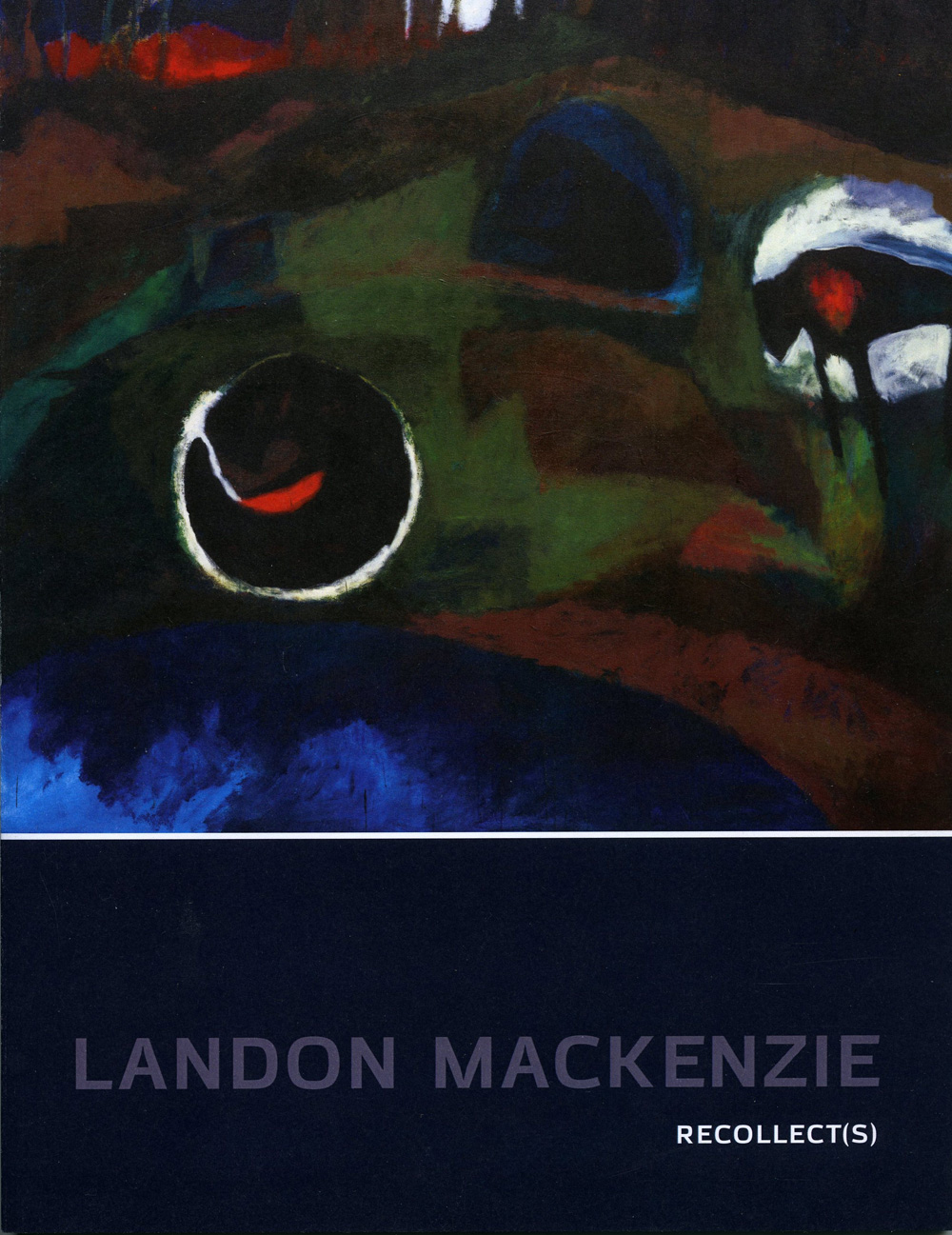
Mackenzie, Landon. “Recollections: A World of Pictures.” Essay included in exhibition catalogue for Landon Mackenzie: Recollect(s) at the West Vancouver Art Museum, 2019. Pages 9-16.
TORONTO
My parents, Sheila and Michael, met when they were university students in the 1940s, and in 1950 they married. They loved art and in particular abstract painting, evolving as it was at a cutting-edge moment in time. It was tied up in their love, my mother’s eccentricities, my father’s belief in modernism, and in their ultimate demise as a couple. They were passionately
involved in Toronto’s progressive cultural and political scene in the 50s and 60s and believed that artists made exciting and important things that were worth their attention. The city was changing; it was then, as it is now, made up of many Torontos. In their milieu were others who had met at Trinity College at the University of Toronto in the 1940s or had likewise continued on to Cambridge, Massachusetts for graduate school. Friends and family were professionally involved in writing, broadcasting, art, business, politics and foreign affairs.
My father was incredibly bright and, having suffered serious childhood illnesses such as polio, was well ahead in books and numbers by the time he did his first degree in history. My mother, who was born and raised in Chile, with a Toronto-born father and a mother from Baltimore, spoke and read three languages and was imaginative and worldly. In either praise or putdown, the neighbours would say: “That Sheila (Higgins) Mackenzie is very Modern!”
By 1959 we’d moved into a three-story, red brick Victorian house at 39 Rosedale Road, at the corner of Cluny Avenue. Built in 1889, with turn-of-the-century elegance, the basement was rough, the plumbing old and the electricity sometimes sketchy, but it was on a street lined with elm trees and conveniently close to the subway. The front yard soon sported a modern, welded and painted, tall steel structure by Walter Yarwood. A series of interesting people lived in rooms on the third floor, and it was a great house for late-night parties.
My parents painted out every bit of darkness (including the piano) to make the house less gloomy. No matter the value of varnished wood and dark green walls in Rosedale, they made everything white—the only exception being the lines of fine 19th century wall moulding that mum painted with a formula of gold particles and banana oil. In the living room, hall and dining room, and wherever wall plaster was cracking, pictures went up: gestural abstractions or collages from 1954 to 1963, all by artists they knew or from friendships with dealers like Dorothy Cameron, Av Isaacs and Alvin Balkind.
My father was a chartered accountant with Clarkson Gordon, and my mother, an intellectual, was a former social worker. I was born in 1954, the first of four children; my siblings were born in 1956, 1958 and 1960, with a miscarriage in between. Sheila aspired to the post-war housewife model prevalent at the time, but had little interest in housework, and often bought our provisions at Pickering Farms supermarket, which was close to the Isaacs and the Here and Now galleries (later the space of Carmen Lamanna) on Yonge Street, and a bar on Cumberland called The Pilot. We didn’t have a car, but the galleries were only a 20-minute walk from home, and I was often deposited on their benches to care for the groceries while my mother, who was glamorous and articulate, visited with the other grown-ups on afternoons. This is where I saw shows by Michael Snow, Joyce Wieland, Tony Urquhart, William Kurelek and many others, and where eventually some of the adults took an interest in talking to me. My cousin Charles worked in the back of the Isaacs Gallery while we were in high school.
The artists in this new scene were nicknamed the Isaacs Boys, as opposed to an older cohort active in Toronto from 1953-59, called the Painters Eleven, whose name was coined by Harold Town. Bill Withrow, director of the Art Gallery of Toronto (AGT-changed to the Art Gallery of Ontario or AGO in 1966), told my mother that the parties at 39 Rosedale Road were a rare truce between the two groups! My father was on the Art Gallery Board and my mother was keenly involved with the volunteer Women’s Committee, a network of art-savvy, well-educated socialites who, like her, wanted to make their own decisions about buying progressive art without too much interference from the men.
Led by dedicated arts ambassador Jeanne Parkin and other friends, the women raised funds by various means—including using my mother’s idea, cashing in their federal Family Allowance cheques—to acquire works by the New York School to donate to the gallery. My mother was one of the inner group and went to New York in 1965 or 1966 to buy Andy Warhols Elvis I and II (1963; 1964) with some of those funds. In an interview, Jeanne said they paid $6000. My mother told me that Brydon Smith, the curator of contemporary art, was hoping for a Barnett Newman, but the Women’s Committee insisted on donating the sex symbol Elvis instead!
I am told that as a child I was very observant. I was five when we moved into the house on Rosedale Road, and the pictures on our walls were my orbit, large enough that I could look right into them and before we had TV. These paintings were not background decoration but real and dynamic experiences that carried more ideas than paint. Big pieces by Harold Town, Michael Snow, Walter Yarwood, Gordon Smith, Gordon Raynor, Toni Onley, Gerald Gladstone, and only one woman, Rita Letendre, taught me colour, form and composition. There wasn’t a Wieland, but there was Joyce in person in our kitchen or at the Isaacs, and by the time I was 12, Time Machine Series (1961) was hanging in the AGO, where I could also see the dark landscapes of Emily Carr.
My mother was an excellent and passionate writer and kept up lively correspondences with, among others, Alvin Balkind, a curator and dealer who on one visit from British Columbia, brought a sheet of slides showing paintings by artists such as Jack Shadbolt, B.C. Binning, Toni Onley and Gordon Smith, whom he represented in his New Design Gallery in Vancouver (founded in West Vancouver in 1955). I was told that my parents threw a dinner party in Alvin’s honour and, by the end of the night, most of the paintings had been sold to their friends on the guest list. Two Gordon Smith paintings (c. 1954 and 1958) were shipped to our home and became part of my world of pictures.
A large red and green Jock Macdonald painting lived in my grandparents’ home, where I watched it regularly. It’s a beautiful picture from 1957 with both Forbidden Valley and Lost Valley written on the back. Alice (Allie) and Hugh Mackenzie were friends of Jock and his wife Barbara. Allie, with all of her kids, painted with Jock in Banff the summer of 1946, and they both taught classes at the Heliconian Club, an arts and letters organization for women in Yorkville. An accomplished painter and illustrator who trained in New York, my grandmother worked for a while in the design department at Eaton’s College Street. In the 1960s, she had a studio on Markham Street and also painted some winters in San Miguel de Allende, exhibiting her works in Toronto at the (Jack) Pollock Gallery. Her Markham studio is where I remember making my first real painting: a still life she had set up for me with an eggplant. When I was 12, I spent a few winter months with her in Mexico where she was at the art school every day painting in the studios.
In my parents’ house was a smaller Jock Macdonald piece, an ink and watercolour he made in France in 1954 that was his wedding present to them. Always in our living room, it influenced how I thought about making my own works on paper. Jock was a prominent figure in the Painters Eleven who also taught at the Ontario College of Art (OCA), but later I learned that he started to paint and to make abstract pictures in British Columbia, and that he knew Emily Carr. He came to Canada for a job at the new Vancouver School of Decorative and Applied Arts in 1926. Twenty-one years later, after also teaching in Calgary and Banff, he moved to Toronto. That story played a role when years later I decided to uproot my own young family in the east to join the faculty at the same institution, first renamed the Vancouver School of Art and then subsequently the Emily Carr College of Art and Design (now University). Trained in textile design in his native Scotland, Jock’s palette of colours, paint sensibility and compositional structures so clearly influenced my own early paintings, that my grandmother left me Forbidden Valley when she died in 1989.
Other relatives had pictures too. My Higgins grandparents had a symbolic and fascinating reproduction of a dreamy picture by William Blake in their apartment. After spending their working lives in Chile, they moved to Castle Frank Crescent (near the Bloor Viaduct), and across the street from Harold Town and his family. My Higgins aunt and uncle also had some works by William Kurelek including, in their words, a “full moon over an ice and snowy landscape.” On the Mackenzie side, my aunt Dot and uncle Hugh were both skilled figurative painters who trained at Mount Alison with Alex Colville. Their works and other artists pictures they received as artist trades, were spread throughout their house and Hugh (called Whay) kept a studio in the attic. He taught drawing at OCA and Dot made portraits that really looked like people! Through them I met artists like Greg Curnoe, Mary Pratt and Tim Whiten.
THE NEW YORK TRIP
At the age of 17 l was accepted to art school in Nova Scotia without doing grade 13 in Ontario. Michael Snow, Joyce Wieland and my uncle all said: “There’s something going on down there!” The three of them had returned from making prints at the new NSCAD Lithography Workshop, and the east coast was as far as I could legally get from my family without causing a row. Harold Town wrote me a reference letter and I sent off my three conceptual portfolio projects. To get Harold’s letter I had to go to 25 Severn Street, the Studio Building in the Rosedale Valley that Lawren Harris helped build for the Group of Seven to live and work in. Harold was making his new Snap paintings. These were on large canvases, and there were buckets of coloured paint, oodles of wet strings and empty cases of beer everywhere. I was bowled over; until then
I had only seen the small studio at his home, or my uncle’s or grandmother’s work spaces. This was it, I decided: I WANT THIS!
My parents weren’t happy about my plan to abandon the straight education route, and though they’d been apart for five years (dad left the house in 1966), both fought me on a common front using different methods. They worried that I didn’t have the talent it takes, and both were aware of how sexist the art world can be. But I was determined, and finally mum accepted that l’d made up my mind. “Right!” she said: “Pack a sweater and a nightie. At least I can show you how to look at art.” Then she borowed $100 from her brother and we took a midnight Greyhound bus, arriving at dawn in New York.
We made our way to Greenwich Village to find Auntie Rose, who was Granny Edna’s best friend and fellow nurse in Sewell, the mining town where my mum was born and raised in the Andes. We made Rose breakfast and then “did” the Museum of Modern Art. I remember climbing the swirling staircase to the second level where an oil-on-wood painting by Salvador Dali stopped me in my tracks. The very one from the books: small, polished, the clocks melting on the beach. In the next room huge Picassos and Matisse’s dancing figures, so large, with messy, unpolished thin brushwork and paint. My mother told me to write down the names of the ones that impacted me the most, and even though she said my favourites would change over time, Network of Stoppages by Marcel Duchamp (1914), the one with the subway lines and nodes, has stayed with me ever since. The next day we went to the Frick, the Whitney and the Guggenheim. It was 1972 and soon I would take the train to Halifax on my own. My mother had shown me how to travel cheaply and how to look at works of art firsthand, and I was prepared for art school.
HALIFAX
l arrived by train with $100 l’d saved for my tuition. I found a room in a pretty wild communal house at Dalhousie University near the Art College on Coburg Road. Over the next few years the school moved bit by bit downtown to Duke Street and its historic buildings. My first foundation teacher was Emmet Williams, the concrete poet, and during his class we made a wall drawing by following instructions from conceptual artist Sol LeWit. Motivated by the resistance I felt from fighting my parents to head to Halifax, I at least had learned from them to hope for good teachers and to pay close attention to what they said. In my first week I was in the school’s elevator when the young president, Garry Neill Kennedy, stepped in and told me about the visiting artist talks on Mondays at 4 p.m. in the gallery. He said students would get a free beer and a Cake Box donut if we attended. At the first one there was a guy who played the piano strangely. Later, when he became famous, I pieced together that it was Philip Glass! The next talk was by American performance artist Vito Acconci, dressed all in black leather. The talks were interesting, so I always attended and never ended up studying painting. Instead, I headed to lithography because that’s where the energy seemed to be, and it was run by Bob Rogers like the Marines. I also studied life drawing with Richards Jarden and, on a dare, became the model for the class in January at $6 an hour, which paid my rent.
For graduate school Harold Town wrote me a second recommendation letter that concluded: “You should take this young woman because she has a smile that would stir the crotch of a marble statue.” Guido Molinari and Irene Whittome, who ran the master’s program at Concordia in 1976, agreed I should attend. Irene had already interviewed me when I passed through Montreal to say hello to my father, who had moved there in the late 1960s, and she had a portfolio of my black and white etchings all pulled from a single plate. When their acceptance letter finally reached me, I was far away in the north with my partner, Donald MacPherson, in our back-to-the-land squatter’s cabin on a completely different track. It was a hard decision, but I finally chose to go to school for the fall and then find my way back to the Yukon for Christmas and the next few summers.
In Montreal, Irene arranged to lend me an etching press and I continued the work I’d started in Halifax which, I see now, was influenced both by Conceptual Art’s value of practice as a daily action, and by Harold Town’s obsessive single autographic prints. I never studied painting but listened carefully when Molinari held court. I learned a lot that was useful to this day. After graduate school, I began painting in secret at my studio on Peel Street and then on Rue Clark, and in three years won first prize at the 1981 Quebec Biennial for my Lost River Series. It was a blind jury process and for the next few years I was represented by Galerie France Morin, where things really started taking off.
VANCOUVER
Donald and I moved to Vancouver from eastern Canada in 1986 with our two small children, Cluny and Jeffryn, when I was offered a permanent teaching job. I had been teaching for some years already at Concordia University, commuting between Montreal, where I had work, and Toronto, where Donald was finishing graduate studies. Now in Vancouver I was shocked to find the art department full of complicated, mean-spirited characters. Within a couple of months Gordon Smith, whom I had never met, sent me a handwritten card that said simply: “I hear you are upsetting the apple cart at Emily Carr! Do come for lunch.” I met Gordon and Marion and then Doris Shadbolt and Tak Tanabe, and was also warmly welcomed as Sheila’s daughter by Alvin Balkind and his partner Abraham Rogatnick—even more so when our third baby, Georgia, was born.
We had found a home, but I desperately needed a place to paint and a new studio. By that first Christmas, lan Wallace, Terence (Terry) Johnson and I had taken over a former Emily Carr College space in a second-floor warehouse at 3rd and Columbia, where we’d been teaching senior students in the fall. Along with a few other artists, this started the 188 Studio Building, where at least 70 artists have worked at one time or another over the past three decades, and where six of the founding group, including me, still are.