
Media
Books
Media
Books
Landon Mackenzie: Nervous Centre
A Resolution of the Epic. Landon Mackenzie in conversation with Naomi Potter
Vancouver, July 4, 2012
NP: Your work has been described as cinematic, kinetic, performative, cybernetic, time-based, a stage, a platform. What is your relation to these ideas and how have they been influential?
LM: At NSCAD I would go to all the Monday night visiting artist events on Cobourg Road, no matter who was speaking—like events with the “piano player” who later becomes known as Phillip Glass. It just turned my whole sense of how art could be an expansive, questioning, creative endeavour on its head. I am lucky. I picked up painting clearly accepting a definitive rupture of both Conceptual Art, and later on, the death throws of High Modernism in Montreal after being in graduate school. In Quebec during the seventies, the arguments about close value colours and the legacy of the Automatists and Plasticiens could not have been further from what I had picked up at NSCAD in Halifax. Where the two come together in my work is this idea of daily practice—you set up a game, you play the game, you accept the results. And you cheat!
When I began painting after all my schooling in 1979, I started with imaginary and studio-constructed landscapes. I’d give the picture a backdrop, a few colours, and a mood, then put in an animal, then give it a mate, then give them a family. Then I would wipe them all out. I would change the horizon, make it dark like night, and then turn half the picture into water. This would go on for days and weeks. Probably the reason I won the Quebec Biennial of Painting is that my studio mates at Clark Street, which had been Betty Goodwin’s former project space, hid two of my “Lost River” paintings on me to say “It’s not just process! You really have to be involved also with an ending, and this is a great ending, Landon!” So I have Eva Brandl, Sorel Cohen, and Stephen Schofield to thank. This idea that paintings have multiple endings was a continuation of my printmaking—an endless number of possibilities ideally until the metal was so thin it could not be printed. That way of working was performative: no editions and no need for a final object.
Usually I work on three or four paintings at once and they are dated over a year or two, and in some cases even four as in the series “Houbart’s Hope.” Changing them is sort of like watering your plants, visiting your friends, catching up, trying something, letting it stand, letting it have a small life, then rejecting it, adding to it, always making a new move in response to something in the picture. A small change in a large painting can have an amazing impact, even changing one small square of colour. It’s like a movie. I like the idea that I am living in my own script. I start with a few characters, a few ideas or colours, and then I have a conversation with them, and down the road, the paintings evolve out of these relationships until I am satisfied with a kind of resolution to that epic. The cinema, performative, the stage—this comes from a sense of living in the landscape.
NP: You and the sound composer for film Dennis Burke have collaborated. Do you think your pictures evoke sound?
LM: Several people over the years have mentioned that the work felt musical—jazz like—and it’s also true that I am using methods of improvisation. I also have mild synesthesia, the blending of any two senses, and feel colour quite exotically, or erotically, when I see the right note (colour). Dennis is a friend and long-time colleague at Emily Carr. He has won awards for countless film scores, so he took the challenge to produce separate soundtracks for five of his favourite paintings of mine. When one hears a sound in the headphones, certain aspects of the painting light up and begin to move because neurologically, one’s memory of cinema is engaged. Dennis first came to the studio and saw World of Knots and Troubles and Circle of Willis and said they were just like film stills and movie screens. He set the challenge of creating binaural sound in his lab to increase the effect after we first tested this idea at my show at the Richmond Art Gallery in the fall of 2011. Wearing Dennis’s headphones for the test soundscapes, I found I was able to travel in and out of the painting. Hearing a certain sound made all the red things light up, then the yellow, etc.—the painting literally started moving. Neurologically, I think it is because one joins with some stored memory of how one understands and experiences images through going to the movies. It’s an immersive experience.
NP: In this exhibition we have opted to present twenty works on paper and several of your “suitcase paintings.” How does this work relate to your larger paintings?
When I am in the big studio I work on the big things—though space is maddeningly expensive and complicated to afford. I never like to leave any mixed paint to dry up when I leave a session, so as I finish, I usually use the leftover paint on small, prepared “sidekick” canvases. Occasionally over time, some of these become keepers. The suitcase paintings come from travelling time or doing work away. I mostly work on paper during trips or residencies but sometimes crave to be working on canvas, so I make these little pieces. When I was in Paris in 2009, the pianists below and above me rehearsed all day, so the works are titled “Paris Piano.” I was responding to endless scales! These fit into suitcases to come home, and over time, I have given some of these works to my friends.
With the works on paper, bits end up back in the bigger work or vice versa. By working on paper, I can work on them over and over again. They are portable and I have moved with them, changed them in Paris and again in Warsaw, then Madrid or Banff. What I have understood about being an artist over a long period of time is that these little works are a way for me to have an output to stimulation. When I am travelling, I take in so much new information, new languages, new subway systems, new shapes, light and colour, museum collections, and so by spending a couple of hours or days making these pictures, I am able to “output” something to balance the situation. This is important because I get overloaded otherwise. This in-take-outtake is something that fascinates me.
NP: You have said that you work from an “interest in the intersecting territories of history, maps, waterways, and dark and light space as nervous systems.” Let’s talk about this idea of nervous systems. Can this idea be linked to your intuitive approach to working, one that you have called “patterned memory and chaos”?
LM: I make everything by hand without photographs or projections or preplanning. I change my mind on the spot. I try and gather my nerve to take a new step, sometimes seemingly to sabotage months of my own work, but I risk it. Painting is a form of my nervous system. The patterned memory or chaos interests me. Consider the random ways in which your hands are vaguely active, or preoccupied, like when you are mixing colour and the mind is wandering. A lot of related, deeply intelligent “helper centres” (as I like to call them) are unexpectedly accessed: the neurological concept known as “on the edge of chaos.” The disconnection involved in actually making all of those intricate decisions in a painting over time becomes unretainable, and the practice is an extension of my own nervous system. Or like others before me, maybe I practice painting because I am anxious. My process itself is abstract. I might make up something or pick up a diagram and make a version of it as one of the layers of the outcome, but it’s a flash act of momentary decision making; I trust my instinct. “OK, let’s try that, let’s reject this,” all in a split second. There is a background of research I do and then I work intuitively, rummaging through it. The journey of the painting is abstract, yet the final outcome one might say is representational, but a representation of phenomena we don’t actually have pictures for in the world. In Neurocity (Aqua Blue), images come and go almost by accident. It is in the eye of the beholder, this experience, because you cannot stay focused on any one spot, and it seems to just be made of layered coloured squares or three-inch pixels. I worked on this picture over and over again until there was no point of rest. You can’t find a place where you can settle down. I felt that was a picture of how we are living today and how our brains are working.
NP: The use of colour in your work is very strong. What kind of relationship do you have with colour?
LM: I had colour on an intensely scrutinized mistrust coming out of NSCAD in the early seventies, and then this mixed with the complex justification of colour among Montreal painters and in particular, my master’s degree mentor, Guido Molinari. I felt like I had to get a bit of bad behaviour out of my system, so I made some paper paintings in 1979 and then a bold seven-by-eight-foot painting, which I painted like a ten-year-old with fish and mountains. Yikes, colour and imagery! Thrilling in its defiance, but also disturbing. There was a small “new image painting” scene starting to rumble in Montreal amongst my friends and artists like Lynn Hughes and David Elliott. I started making these twilight pictures and brought the colour in through darker tones and contrasts but then dared to sneak in a “horizon line.” I know these transgressions make no sense any more, but colour and perspective are joined.
The good thing about being in printmaking for years is that if it is a pink you want, you can only make one, so what tone, viscosity, thickness? Is there white added? A pure stain? What red did you start with before breaking it down to pink? With a painting, you can have lots of reds within minutes. Mix them up with a bit of anything else on the spectrum and you have thousands of possible pinks. I mix something up and if I like it, I use it up. It is amazing how electric that is. Colour carries memory and information. I have never studied (or taught) colour theory, so I am not contaminating what I do with a bunch of rules. I am working from a sense of recognition.
NP: Most of the work in this exhibition presents a bird’s-eye view of the world. Why this perspective?
One of my earlier formative experiences at art school was being part of a Sol Le Witt drawing on a certain day in Halifax. We were given precise instructions, and we followed them exactly. Our instructions were to make a huge grid on the wall, and for my square, which was probably about twelve by twelve inches, I was instructed to draw “x” many lines in red pencil, all a certain length and at Le Witt’s instructed angle. It was probably 1973. The grid continues to be a fundamental part of my orientation.
Flying over the country from the East Coast or central Canada to my home in Vancouver, I try to get the window seat and look at the little necklaces of lights below me on evening flights. When I was first working on the “Saskatchewan Paintings,” I started to pay a lot more specific attention. I have covered this country by road, train, bus, and mostly plane easily over fifty times, including some trips from the Yukon and Beaufort Sea all the way to PEI and Newfoundland. Aerial space, looking back down to earth from an aeroplane, is part of most of our lives now. In archive documents, I was drawn to images from when the country was mapped by hand and by astronomy. These also feed into the work as a deliberate reference to the colonization of Canada by the Dominion Land Survey—the grid. We are all getting used to this double vision of the map.
I would say with recent work like Rose Square that the images are more frontal, like a picture frame through which you are looking at thousands of coloured glass windows, pixelized blocks, or an electronic chart. And the painting SimulatorNeurostar is like a child’s drawing of a game simulator of what outer space could be, and one is also looking at it like a TV screen.
NP: There is something about the way you start the paintings, on the floor, which also determines the perspective of your painted performance.
LM: You are right, there is a practicality with starting them on the floor. I can delay my own aesthetic judgments, not just allowing me to philosophically reference Jackson Pollock, but also allowing me to question painting as a pre-thought product. Thinking of landscape as a lived-in space, occupation of the space, I am actually having to crawl all over these things. It’s a very different way of entering the work. The first painting I did on the floor was for logistical reasons—I was eight months pregnant with my third baby and could not get up the ladder, and I had this huge canvas and a hardwood studio floor to staple it to. So a funny personal reason for why I started something led to camping on the work, napping on the work, picnicking on the work, all of which I did for the “Saskatchewan Paintings.” There are two fantastic examples of those in this exhibition. A way of thinking about performance and time, and embracing a frustratingly slow pace of time, and building a theory of fracture into my work or working behaviour was important. I was going between the art school where I was teaching and the studio and the daycare and home; dropping in, adding something, letting it dry overnight to come back the next day and see what had happened. I would start to accumulate these gestures and these surprises.
People forget that when you are making a painting like this, you are working with a material that has a consistency of something between tea and hot chocolate. You are not dealing with a final dried form that people see in the exhibition. Allowing the drips and doodles of the performance to happen, I am in a bird’s-eye view relationship with the flatness and the edge. The edges are specific and meticulously marked and protected so there is no doubt from the start about what centimetre of frame is in or out of the painting. I also walk on them to reach the centre, and for a while I used a floating bridge on casters that I made with Damian Moppett. When I first get them up on the stretchers they are like giant puzzles (I love puzzles). This huge thing I’ve been making for weeks or months on the floor is now on the wall, and then when I look at it, I am often surprised by what I see! Now what do I do with you? I have to figure you out. What are the pictorial instructions, or narrative instructions? What are the oppositions? Then I begin to work toward a finish.
NP: Finally, let’s talk about secrets. This is in response to your work being full of endless readable gestures—gestures that are cloaked with resonance for you but could easily be missed or perceived differently by the viewer. What purpose does this strategy serve for you?
LM: The intellectual dialogues in Vancouver in the late eighties and early nineties focused quite heavily around conversations that challenged the representation of the land from a colonial perspective. My reactions to some art that came out of these discussions, works that had a singular subjectivity or a testimonial in a singular line—“This is my story, I have the rights to tell my story”—examine multiple perspectives and cross-disciplines. Taking a landscape that was fraught with complexity and representing things by physically layering over and over again became a good way to restage my concerns.
In Gabriel’s Crossing to Humboldt, I began with an interview with a geologist to look at how the colonial structure was marked in a geological and political way on the prairie. We walked the canvas with magic markers, and he showed me how he had surveyed Saskatchewan. I covered his diagrams with raised synthetic polymer, just as one would write “Happy Birthday” with sugar icing on a cake. Then, as with Interior Lowlands; Still the Restless Whispers Never Leave Me, I alternated official land histories, records, diagrams, charts, and language of old maps with secrets and songs. My premise was that the land carries all these untold stories that get lost against official trajectories, settler narratives, the railway, and land survey records. Snippets of the treaties are interrupted by country and western songs and conversations I hear in a little diner along Highway 11.
I think that painting can only do a certain job, and the painter can never predict what the experience of the viewer will be, so the more you think you can, the more you are foolish. I like to reward a viewer who takes the time to experience the work or rummage, and there is a lot of material. If they want to find a sentence, a map, a chart, a compass reference, they are rewarded for taking the time to look and find. The other thing that I know about these works is that you could visit them every day of the four months of this exhibition and you would find a different thing each time. I like paintings that cannot be remembered
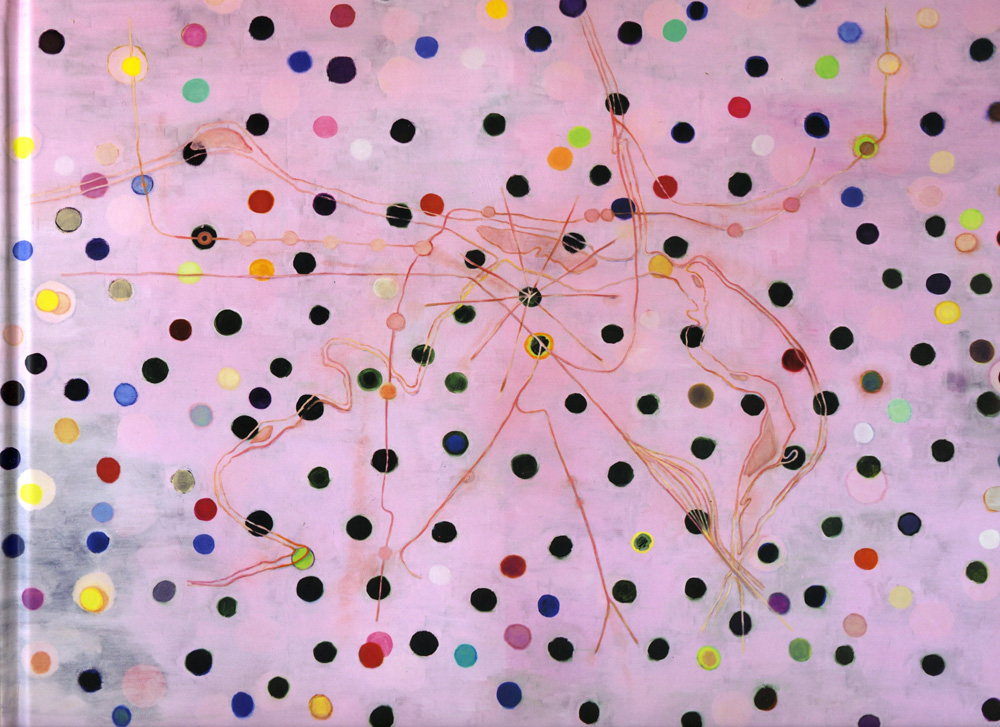
Compared to these complicated works from the nineties, later works like Wild Red seem to be much simpler paintings. In the newest one in the show, Pink Dot, I want it to appear as if I have drawn a line in the sand in counterweight to a bunch of polka dots. I put the original fort of Calgary and the new Atlantic Arts Building, where Esker Foundation lives, side by side, creating a new centre of the city. Giving Esker the compass rose, then stripping the tourist map of all but the transportation systems of the Elbow and Bow rivers and the old Canadian Pacific Railway lines, then the newer CTrain (the urban tram), I was playing with a “Calgary as Paris.” Stepping back, I saw the unintentional and unexpected juggler figure—like a lesserknown early Salvador Dali painting—juggling his world, keeping all the balls in the air, and each dot has its own story or balloon of information. For me, it ties back to the first painting in the show, Interior Lowlands; Still the Restless Whispers Never Leave Me, which is about the land never really being left alone. There you have these oval patches of bare linen that you can see, and by leaving them, I am saying there is a gap in the story. The gaps can be filled by the viewers, or filled with history, or maybe they can never be filled because we have no access to that language anymore, or those people are dead or were never heard to start with. So in Pink Dot, with these little recessed spaces, the pink envelops the circle, or the circle being plotted on top creates both an indigenous space and a colonial space. The landscape is young and hip, wearing a new shirt, and the title Pink Dot is cheeky. When you see the line works, maybe you can see breasts and crotches, little situations that were not known until I finished making the picture.
NP: Is it your sexiest painting to date?
LM: Yes, absolutely it is my sexiest painting.
Reprinted by permission of Esker Foundation. To purchase the 89 page colour book “Landon Mackenzie: Nervous Centre” please go to ‘Publications’ on www.Eskerfoundation.ca