
Media
Books
Media
Books
Landon Mackenzie: Recollect(s)
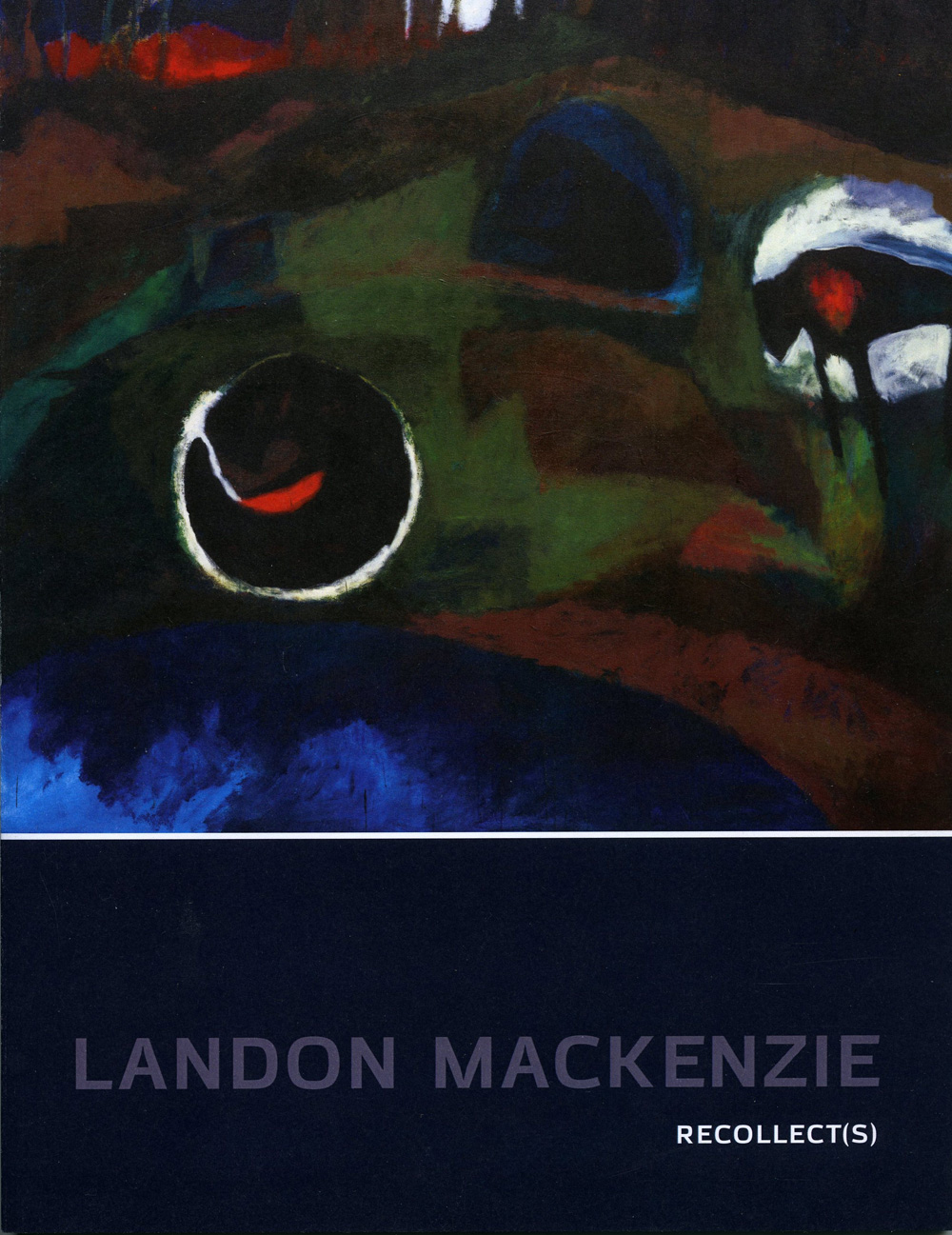
Moray, Gerta. “Genealogies of a Canadian Abstract Painter.” Essay included in exhibition catalogue for Landon Mackenzie: Recollect(s) at the West Vancouver Art Museum, 2019. Pages 19-25.
“Matisse once said: ‘Painting is a priesthood.’ This is my aberration. Like a drug addict or a stamp collector—I’m a painter.”
Harold Town, Indications, 1975
What can we expect from an abstract painter today? The age of mechanical reproduction has been with us for a century; it is now compounded by the internet with its Niagara Falls of digital reproduction that can gobble up, combine and regurgitate every form of image production. Taking over a role once filled by paintings, this new imagery directs our lives, focuses our desires and our goals, and channels our attention through a mediated picture gallery of the wider world.
Abstract painting, on the other hand, has never really won the public’s heart. We should remember that one of the motivations that drove art into abstraction was resistance to the reign of the camera, that tool of mimesis. Painters from the Impressionists on found things to do that a mechanical device seemingly couldn’t: to conjure up subjective inner worlds, intuitions and sensations. Then, as new avant-garde art movements became increasingly abstract, they were portrayed by the press as transgressive, scandalous and transitory—a perpetual “shock of the new.” That is, until today, when abstract art is generally relegated to the realm of a special interest group. Once so passionately pursued and equally angrily dismissed, it now tends to be thought of as mere upmarket interior decoration.
A self-described rebel, Landon Mackenzie makes a contrary claim for abstract painting, as a language still valid for thinking about shared human experience and contemporary realities, able to stand alongside the proliferation of new media and the more easily consumed realist figurative painting. Over her career she has developed works that absorb our attention through time and that address our lives by infiltrating our dreams, our sense of place, even our conception of our bodies. Her work is at once sophisticated and accessible; it has been acquired by major art museums and commissioned by the Vancouver transit system to symbolize the city’s identity when hosting the Olympic Games.
Why does Mackenzie persist in making her art in the form of abstract painting, when overwhelming cultural change has left it little claim to public attention? And how is it that a painter of her generation could emerge in 1980 with such ambitious paintings, made in Canada but addressing a global world? As an art historian, these are the questions with which I shall consider this current show. Fortunately, Mackenzie volunteers to be our teacher and guide. Presenting a selection of her own work beside artworks that she lived with as she grew up, she reveals her creative relationship with historic Canadian abstract art, a tradition that has inspired her and that she recollects for us today.
THE SUBJECTS OF THE ARTIST
Landon Mackenzie was born in 954, in the same year that a heterogeneous group of artists caling themselves Painters Eleven held their first joint exhibition in Toronto. At a time when the Group of Seven still dominated the public’s notion of modern art, these artists wished to stage a show of strength for experiments with gestural abstraction. They had no shared manifesto or style but were inspired individually by prewar and postwar Europe and by the Abstract Expressionist scene in New York. Works by three members of that group, Jock Macdonald, Harold Town and Walter Yarwood, hang in the current show, collected by Mackenzie’s parents and grandparents, along with abstract paintings by Michael Snow and Gordon Smith from Vancouver. Her family were keen supporters of these new developments at a pivotal moment
when abstraction seemed at first a bold wager, then the inevitable direction of history.
It is hard to reimagine today the sense of liberation and adventure for artists and the public
alike brought about by this new mode of painting. Gordon Smith described his experience
when forced to try out an abstract approach at a summer school at the California School of
Fine Arts in San Francisco in 1951: “I put my canvas on the floor and started playing around
with this paint. It became for me an exciting experience just manipulating paint. It was the
best damn thing that happened, it was a real shock treatment.” In 1955 the National Gallery
of Canada held its first Biennial Exhibition of Canadian Painting, and Smith’s highly abstracted
landscape painting, Structure with Red Sun, won first prize.
Debates about meaning and about the role of subject matter have always accompanied abstract art movements, and when four prominent New York Abstract Expressionists,
Mark Rothko, William Baziotes, Robert Motherwell and David Hare, set up an art school together in 1947, they named it The Subjects of the Artist and stated in their program:
“It is the school’s belief that more is to be gained by exposure to the different subjects of all four artists—to what modern artists paint about, as well as how they paint.”
As Canada shook off its insularity after WWII, organized groups of young abstract artists sprang up in several regional centres during the 1950s, each with their own passionate subjects and concerns. The Automatistes in 1940s Montreal, to whom Rita Letendre belonged, were the first. Their move into a version of Surrealist automatism was politically charged, a rejection of all social conventions in the face of the humanitarian crises of the war and the conservative theocracy that was paralyzing Quebec. They put their trust in the regenerative powers of the unconscious and dream.
In Vancouver, Jock Mcdonald had made solitary forays into abstraction during the 1930s and 40s with very different horizons. Picking up on the transcendental vision of the early pioneers of abstraction—Kandinsky and Mondrian in Europe and Lawren Harris in Canada—he used organic forms to evoke an underlying cosmic order. After moving to Toronto in 1946, Macdonald attended the summer school in Provincetown, Massachusetts, taught by Hans
Hofmann, and brought his formal organization of paint on the canvas into line with the New York school. Painting became self consciously about the push and pull of colour creating space, and other members of the Painters Eleven, Alexandra Luke, Hortense Gordon and Wiliam Ronald, also went for instruction to Hofmann, as did several artists from Vancouver. A strong feeling of solidarity flowed among these far-flung members of a pioneering
generation. Many of them corresponded (Jock Macdonald with Gordon Smith, for
example, and Harold Town with Jack Shadbolt) and they helped arrange for gallery shows of each others’ work. It was this community activity that enabled Landon’s parents to acquire paintings from Toronto, Vancouver and Montreal.
Two underlying themes shared by much of the 1950s generation are central to Landon Mackenzie’s work. Landscape (whether natural or urban) was a point of reference against which artists would create their individual visions, however abstract their work might look; and their love for the distinctively Canadian environment prompted a desire to make art that would enrich the public realm. The Group of Seven had already offered up an “art for a nation.” In a more complex way, loyalty to his local experience confirmed Harold Town’s resolve to stay in Toronto, not New York or Europe, and prompted Joyce Wieland to focus her 1971 solo exhibition at the National Gallery on the theme True Patriot Love. Mackenzie’s paintings are abstract landscapes, maps—internal or external, from home or abroad—that address public concerns.
Mackenzie’s essay in this catalogue eloquently evokes her immersion as a child in the abstract art scene of the 50s and 60s. The vivid, inscrutable paintings on the walls of her home created inexhaustibly mysterious worlds. After her early exposure to “what modern artists paint about, as well as how they paint” she moved on as an art student during the 1970s through successive revolutions and reversals: first to an iconoclastic institution where painting was dismissed, and then to a graduate school where it was rebelliously but critically renewed. The current exhibition shows that the Toronto art she was first immersed in had taken deep root in her imagination; it was sufficiently intense and varied to give her the confidence to gradually formulate her own deeply felt subject matter, while offering her technical resources she could return to as she worked in new places and with new problems.
One Toronto artist has played a particularly vital role in her development. A strong friendship existed between Harold Town and Landon’s parents. Harold loved to hold court at their parties, and Landon’s grandparents lived across the street from the Town family. Her brother Hugh became Harold’s trusted assistant at the annual ritual of decorating the Towns’ Christmas tree with lights and hundreds of glass balls, which in their visual dazzle and excess paralleled the patterned op-art paintings that Town was making by the mid-60s.
In 1964, the Mackenzies had asked Town to paint a mural for their living room. It was to cover an entire wall, and heated discussions ensued as Harold insisted that they get rid of the sofa, the piano and the fireplace. They had anticipated having “the lovely, floating ‘easy’ forms and luscious sensuous thickly painted colour” of his earlier work, the “dream of richness of little secret anecdotal floating bits that one might discover and savour one by one, now here, now there, a galaxy of myriad independent moments,” as Sheila Mackenzie wrote to Harold. But
Town was transitioning out of his Tyranny of the Corner series, marshalling crowds of dots, scribbles and doughnut-like circles against larger dark stencil-like shapes on thinly painted almost monochromatic fields. He had invited them to his studio to “see the world in which we shall sit,” and Sheila assured him, “I accept all that is involved in the honor of having our wall in a common possession, and have given up all legal and moral rights to try to control it.”
Town was a protean force in Toronto throughout Landon Mackenzie’s teenage years, testing himself against a series of stylistic idioms with complex virtuosic displays. His legacy to her, apart from writing references for her art school applications, was his continual openness to new developments in art and culture generally (he praised “happenings,” for example) and his amazing compositional inventiveness in creating abstract paintings in response to his world.
PORTRAIT OF THE ARTIST AS A YOUNG WOMAN
Mackenzie’s relationship to painting was put on hold by her decision in 1972 to study at the Nova Scotia College of Art and Design. Known by its acronym NSCAD (now NSCAD University), the college was at the time less a typical art school than the flagship of a new international art current: Conceptual Art. Under a youthful president, Garry Neill Kennedy, the school was to be a laboratory for a technological age. It was time to reject traditional disciplines and formats, to spurn the commercial marketplace, to find new ways to express new ideas. Grades were abolished, and students were exposed to visiting experimental artists from the US, Europe and Canada, who came to teach a semester, display their work, or use the college’s outstanding lithographic workshop. The Americans ranged from Lawrence Weiner to Vito Acconci, the Europeans from Joseph Beuys to Daniel Buren. Michael Snow and Joyce Wieland, artist friends of the Mackenzie family, had both been in NSCAD’s visitor program, as had Landon’s uncle, painter Hugh (Whay) Mackenzie. Their reports that something exciting was afoot at the college influenced Landon’s choice to attend.
In this environment of art’s return to ground zero, she entered the printmaking program, which still retained a traditional discipline. She was expected to master all the available lithographic and later intaglio processes—engraving, drypoint, etching, acquatint and so on. Some of her 1975 prints, Daily Etchings (Halifax), included in the current show reveal howshe was turning those techniques to abstract, painterly effect. But in the conceptual spirit of the college, her prints were products of a proposition. Rejecting the normal printmaker’s goal of producing a completed work in a numbered edition, she would make the etching plate a daily record. Her acts of engraving and biting the plate were punctuated by erasure and accretion. Without the pressure of a prescribed end-product she could explore and discover. Her foundation course
under visiting instructor Emmett Williams embraced the Fluxus movement’s conviction that life should flow into art, and his concrete poetry turned words into visual art. Landon’s prints became repositories of her daily experiences, of words and music, markers of time and of physical performance.
The work she produced then shows that her commitment to abstract art was axiomatic. Three of her Toronto mentors had provided parallels for her working approach. Michael Snow’s painting India (1959), for example, at first sight makes a landscape-like impression but, on closer examination, it draws attention to the artist’s physical acts and deliberative decisions in paint application. Snow’s repertory of marks is a self-conscious interrogation of the qualities and potential of paint. Snow’s wife Joyce Wieland was important to Mackenzie too, especially her feminist symbology. The paintings Wieland made in 1960-61 had an exploratory handling similar to Snow’s, but their thinned, stain-like paints generated large playful diagrammatic forms. Wieland called them her “sex paintings,” and Landon always remembered Time
Machine Series (1961), which she saw in the Art Gallery of Ontario.
Process-driven exploration and symbologies were combined in Harold Town’s work too. The Mackenzies owned one of his single autographic prints (non-editioned, unique works made on a lithographic stone). Second Flight for Icarus (1954) is an early example using black ink and primarily graphic means. Town creates a sense of airy space by three broad sweeps of ink applied with a roller, leaving a white triangle of light at the centre. The surface is traversed by swooping and soaring lines and arcs that can be read as hints of figures, of flight and perhaps of Icarus’s falling feathers. On her intaglio plates, Mackenzie too explored transitions of dark and light, and clusters of lines and shapes that crystallized into hidden symbols, signalling her own presence within sheltering geometric forms.
Harold Town’s large collages embedded such personal symbols with everyday ephemeral materials. An excellent example, Wall for Hammurabi No. 2, hung in the hallway of the Mackenzie home. The viewer can project any number of narratives onto this puzzling, playful piece. Ghostly figures seem to materialize from adhered tissue papers; Town often appropriated his wife Trudy’s discarded dressmaking patterns and in this collage he glued on a piece of her maternity dress. A bird-like apparition perches in a nocturnal window frame at the top left. As Sheila Mackenzie notes, there are “little secret anecdotal floating bits that one might discover and savour one by one.”‘ Landon herself has pointed out that she borrowed the bird from Town’s collage and turned it ambiguously into a seal or a pear in a series of glass-plate monoprints she made in 1974, prefiguring her use of hybrid animal forms as surrogates for humans in her later paintings. In these monoprints, such as the one displayed here, she experimented with the superimposed colour layers that were characteristic of Town’s single autographic prints. The process of layering and incorporating heterogeneous elements implied a horizontal surface work area, like a work bench or a print-bed. This was the “flatbed” method of composition that critic Leo Steinberg pointed out was a revolutionary break with Renaissance perspective in the work of Robert Rauschenberg. This method of picture making, introduced to her by Town, would ground both Mackenzie’s prints and subsequent painting practice, and culminate much later in her epic conceptually-based landscapes of the Saskatchewan Paintings and the Houbart’s Hope series.
After several years of regarding herself as a printmaker, Mackenzie at last succumbed to an identity as a painter.” Her Lost River Series paintings (1981-82) and subsequent animal paintings through to 1985 dominate the current show with their size and dark intensity. They immediately declare their affinity in colour and mysterious allusion to the 1950s paintings from her family collections alongside which they are hung. But they were made in response to very different times.
Mackenzie was now in Montreal, having completed graduate school at Concordia, where her thesis supervisor Irene Whittome, also a printmaker, was creating mysterious sculptural objects and installations that answered to emerging feminist work in New York, the “Eccentric Abstraction” defined by Lucy Lippard, and the work of Louise Bourgeois. A dominating presence at Concordia was Guido Molinari, whose abstract paintings were completely non-referential, dedicated and rigorous research into the phenomenology of the picture surface and of colour presented in vertical hard-edged stripes. Molinari insisted above all on the importance of painting as a significant mode of knowledge. He encouraged Mackenzie and other Concordia graduates who were drawn to the return to figurative imagery signalled by the Whitney Museum’s show, New Image Painting (1978), by the work of Philip Guston, by Neo-Expressionism in Europe, and by a host of big international exhibitions, one of which, The European Iceberg: Creativity in Italy and Germany Today, would hit the Art Gallery of Ontario in 1985.
Armed with her prior experience, Landon Mackenzie stood out within this trend for her sophisticated sense of pictorial form and symbolic narrative. Her Lost River Series, with their dark, multilayered colour areas and hybrid animal-like forms, evoke landscapes but are formal, abstract, unreal. Inspired by memories of her time in the Yukon in 1976-77, when her partner Donald worked in a mine and she as a road sign painter, Mackenzie imposes a dark apocalyptic mood on the time-hallowed national theme of wilderness, allowing ambiguous narratives to emerge. One such painting, Crossing (long) (1984), was triggered by an actual ecological disaster, when thousands of caribou were swept to their deaths at their traditional
crossing-place on the Caniapiscau River after a water release from a Hydro-Quebec dam. Mackenzie’s practice had long been to incorporate personal symbols into her work, and she now added a feminist awareness of maternal experience. Her son Cluny was born the previous year, and Crossing conceals the tiny figure of a child among the feet of the animals, as it reaches out to interact with a white animal form at the left.
For several years Mackenzie combined such personal motifs with abstract landscape spaces, until in the 1990s she returned to processes from her printmaking days of layering successive accumulations of experience and of data. The resulting landscape mappings of Saskatchewan and the north are huge public balance sheets, unravelling in a canvas arena the traces of a harsh colonial history, of contemporary voices and personal struggle, the hopes of early settlers, the ravages of industrial domination, geographies both imagined and real.
SORCERER’S APPRENTICE TO NEUROSTAR
At every stage of her career, Mackenzie has been able to draw inspiration from the mid-century Canadian abstraction that surrounded her as she grew up. Her work offers us historical continuities and critical reflections on the themes and forms of the past while it crystallizes clear and powerful symbols for our current predicament. We are in an age where things burst apart into new spaces created by powerful forces of dispersal.
With the most recent works in the show, Neurostar-North Star (Satellite Yellow) (2012), and her particle paintings, represented here by Tao Hua Tan (THT No. 5) (2018) and Cormorant (Birds Tagged and Found Dead in Winter) (2019), Landon turns to the pictorial dynamism of Harold Town in the 1960s, when he was transforming patterns and optical phenomena into narratives of clash and balance.’ Town was inspired by the urban industrial environment; his paintings referred to Toronto’s intermingling of organic and geometric, of parks and buildings. Like Town, Mackenzie incorporates the structures and forms that she finds in her environment, which now has a global range as she partakes in a web of artist exchanges from Paris to Berlin, Spain and China. With their radiating centres and dispersal of repeated elements, her paintings achieve great clarity and simplicity. They harness the structural rigour of Molinari, the inventiveness of Town, the rich colours and spatial modulations of Gordon Smith and Jock Macdonald. Mackenzie indeed recollects. She comes through on her wager that abstract art is a visual language, and teaches us its historical wealth of suggestion and nuance.